Monotony

I awoke in an old office building, the reddish hue of a sunset illuminating the windowed walls. The room was barren and dilapidated when a voice emerged from deeper inside. I followed the low rhythmic melody, the words just faint enough to be muffled throughout the echoing hallway. I strode closer to the voice, slow and steady, without fear or hesitation, which I found odd. 

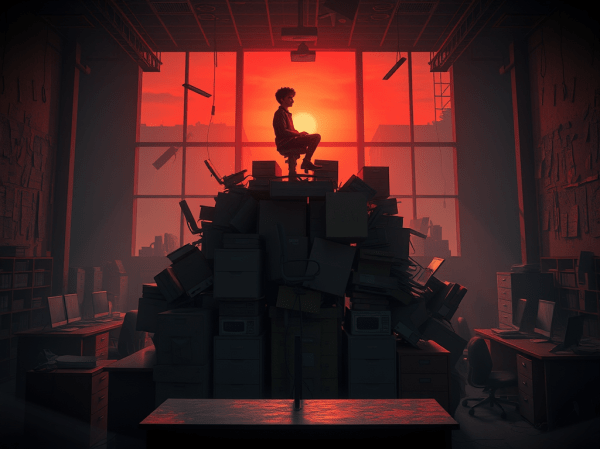
As I came upon its source, rounding the doorway to the room, the sight before me was strange. Inside were office chairs, tables, and filing cabinets, all piled together in a pyramid-like mess. Atop the pile, looking out toward the same reddish sky, sat a boy my age. His song had either ended, or he had heard me enter, for he no longer sang. He paused momentarily before slowly switching his gaze to meet mine as he looked down at me. 

“Hello.” 

A soft smile and kind eyes accompanied his words. His other features seemed unimportant, as they never stayed the same. I tried to speak, but my voice wouldn’t let me. The room became a blur, shifting into darkness as I strained my eyes to keep looking. Suddenly, a bright light hit them, and I found myself in bed. 

Instinctively, I grabbed my phone to see my alarm was one minute away from its loud wake-up call. I showered, put on clothes, brushed my teeth, ate breakfast, and exchanged passing words with my family before making my way to school—the same simple routine I always followed. Only a year ago, I cared what the other girls thought about how I dressed or what boy might be looking my way as I walked down the halls. I couldn’t remember the exact day I gave up on those insecure thoughts or feelings. 

Even as I stopped caring, people around me treated me the same. I still had my friends, my enemies, and those whose interest in me seemed to rise or fall. Nothing about my routine ever changed, even though my mind was no longer present. My therapist said I was disassociated, but as long as my grades remained decent, my parents never seemed overly concerned. 

The school day continued in its favorite manner: holding time to a standstill. My thoughts drifted from the teacher’s lecture to memories of the boy. I tried to envision his face or recall the words of his song. I was half-tempted to sleep through class to see if I could continue the dream, but I have never fallen asleep easily. 

The school day ended, as it did every day, except on weekends when my mind was granted a two-day reprieve. Even at home, the ritual continued: chores, homework, and relationships. Only when I closed the door to my room and began watching or reading did a new story begin. I loved imagining the possibilities in those made-up worlds and stories; they came close to what I’d seen in my dreams. 

I walked down a spiral staircase, moving from one underground room to the next. I saw old luxurious architecture, 1990s-style arcade movie theaters, and a sprawling dark cave with a glass castle inside. I watched large albino-like dogs with almost rodent-like features scurry away from the light illuminated by the building. 

I found myself wandering inside without ever seeing a door. Its glass furniture made it hard to navigate, but the lights and water fountains made the place more beautiful than words could describe. Then, past a glass wall, I saw the boy. He looked different, yet I knew it was him—that implanted knowledge dreams provide, like a distant memory. 

Finally, my words came. “Who are you?” 

His face held the same soft smile, but mixed emotions lingered behind it. 

“I’m afraid I’ve forgotten. Would you tell me yours?” 

“Elaine,” I said, my tone almost standoffish. Yet inside, my chest grew warm, and I wanted to be closer to him. 

He cocked his head and smiled, this time more playfully. “It’s very nice to meet you, Elaine. Do you come here often?” He snickered as he asked. 

“I don—” 

“Not this place, I mean, but where we are.” As he spoke, I heard the fountains grow louder. When I turned back toward them, I saw a beach with an ocean stretching endlessly under a bright yellow sun. The sand sparkled the same hue. I heard faint conversations and laughter, yet the beach was empty except for the boy and me. 

“This place likes to change on you, like scattered thoughts,” he said, gazing longingly at the horizon and then at me. 

When he stared into my soul, I felt something new inside me, like an undiscovered emotion. As I searched for the words to express it, he spoke instead. 

“Would you like to fly?” 

I looked at him, confused, but he met my gaze with his usual smile. Then, he stepped closer and placed a hand on my lower back, wrapping his arm around me. In my mind, I knew something was off—I would never let a stranger hold me like this. Yet, when he did, I felt a wave of comfort. 

“It starts from here. Focus your mind on this point,” he said. 

Instead of questioning him, I followed his instructions. My body began to feel weightless. Looking down, I saw myself drifting off the ground. I flailed for a moment until the boy grabbed my hand, guiding me like a tethered balloon. Together, we looked down at the sunny beach and endless ocean. 

This world felt peaceful and serene, yet melancholy. I looked back at the boy. His face held a tenuous smile tinged with sadness. It became a struggle to keep my eyes open and focused on him until, finally, I could only hear his voice. 

“You’re fading. Don’t panic—just relax. We’ll see each other again.” 

As my eyes closed to one world, they opened in another. I saw my mom in a panic above my bed, holding her phone with trembling hands. 

When our eyes met, she rushed to hug me. “Oh my God! You’re okay! You had me so worried! Don’t you ever do that again!” 

“What’s going on?” I asked, still in a haze. 

Focusing was hard, as my mom explained that I wouldn’t wake up. She had tried shaking me, screaming, but nothing worked. She was about to call the paramedics when I finally stirred. 

Even this event—a break in my usual routine—did not untether me from my cycle. My father insisted nothing was wrong with me and sent me to school, even though I was late. 

Yet, as I droned on, barely connected to reality, something unusual happened. At lunch, my usual table was occupied by someone sitting alone. He looked young, probably a freshman. As I approached, he noticed me and hurriedly began packing his belongings. 

“You can stay if you want,” I said without much expression. 

He stopped, briefly glanced at me, and then sat back down. When my friends joined me at the table, chatting about nothing of importance, I couldn’t help but notice this stranger. 

Looking at him, I asked, “What’s your name?” 

The question interrupted one of my talkative friends, who looked surprised. The freshman seemed even more startled by my sudden interest. 

“Jacob,” he muttered. 

I could hear my friends whispering, “Does she know him? Who is he? Why is he at our table?” 

“I’m Elaine,” I said in my usual detached tone. 

Jacob nodded and continued eating in silence. Looking back, I wish I had spoken more to him—this person who briefly disrupted my endless cycle. 

Night couldn’t come fast enough. As I lay in bed, waiting to fall asleep, insomnia struck. I tossed and turned, growing angrier with each passing moment, desperate to return to my dream world. 

When I finally drifted off, I found myself walking down a surreal street. The houses were oddly shaped, colored in childlike crayon hues. A light fog hung in the air. I wandered, exploring these strange homes, some of which seemed melted or fused with the outdoors. Secret doors led me deeper into this peculiar rabbit hole. 

Inside one of the houses, I saw a familiar face. It struck me that I hadn’t encountered anyone new in my dreams for a while. I walked closer and greeted him. 

“What are you doing, Jacob?” 

Jacob looked at me, his glasses obscuring his expression. “Just hanging out,” he said, gazing at the Seuss-like neighborhood. 

“Have you seen another boy around here?” I asked. 

He didn’t answer. When I turned to look at him again, he was gone. Then, I heard him cry out from somewhere deeper within the fog, toward where it grew darker. Compelled by something I couldn’t explain, I ran toward the sound. Jacob screamed a few more times before falling silent. 

I wandered for what felt like hours as the fog thickened. Then I heard a voice I loved—familiar, soothing. I looked up a small hill to see the boy sitting on a swing, gazing at the starless sky. 

“It’s good to see you again. Have you been practicing your flying?” he asked, shifting his gaze to meet mine. 

I started walking toward him. “My friend—” I began, but then I noticed something. 

Another shape, large, writhing, and ominous, surrounded the boy within the fog. It moved in tandem with his gestures. A sense of horror settled over me, rooting me in place. I stopped climbing the hill. 

“Come, Elaine. I have something new to show you if you’d like to see it.” 

His face and voice remained warm and inviting, but the heaviness in my stomach held me back. I took a step away. 

“You don’t have to leave,” he said, genuine sadness lacing his words. 

I tried not to listen. Closing my eyes, I willed myself awake. Then, I felt his hand on my face—warm yet freezing, sending a tingling sensation through my skin. Still, I kept my eyes shut. 

“Just stop!” I screamed as I woke up. 

I found myself hooked up to an IV in a hospital room. The sensation of his touch lingered on my skin. 

I later learned I had been in a coma for three months since falling asleep. Countless doctors questioned me about my health, prescriptions, or any pain I might have experienced before the coma. None of their questions applied. Then I told them about the dreams. 

Now I take three different pills. I no longer dream, and I haven’t for forty-five years. 

This world hasn’t released me from its monotony, and I have grown accustomed to it. Sometimes, I wonder what would happen if I stopped taking my medication—if I would see that boy, whatever he was, again. 

Blog at WordPress.com.

Up ↑