
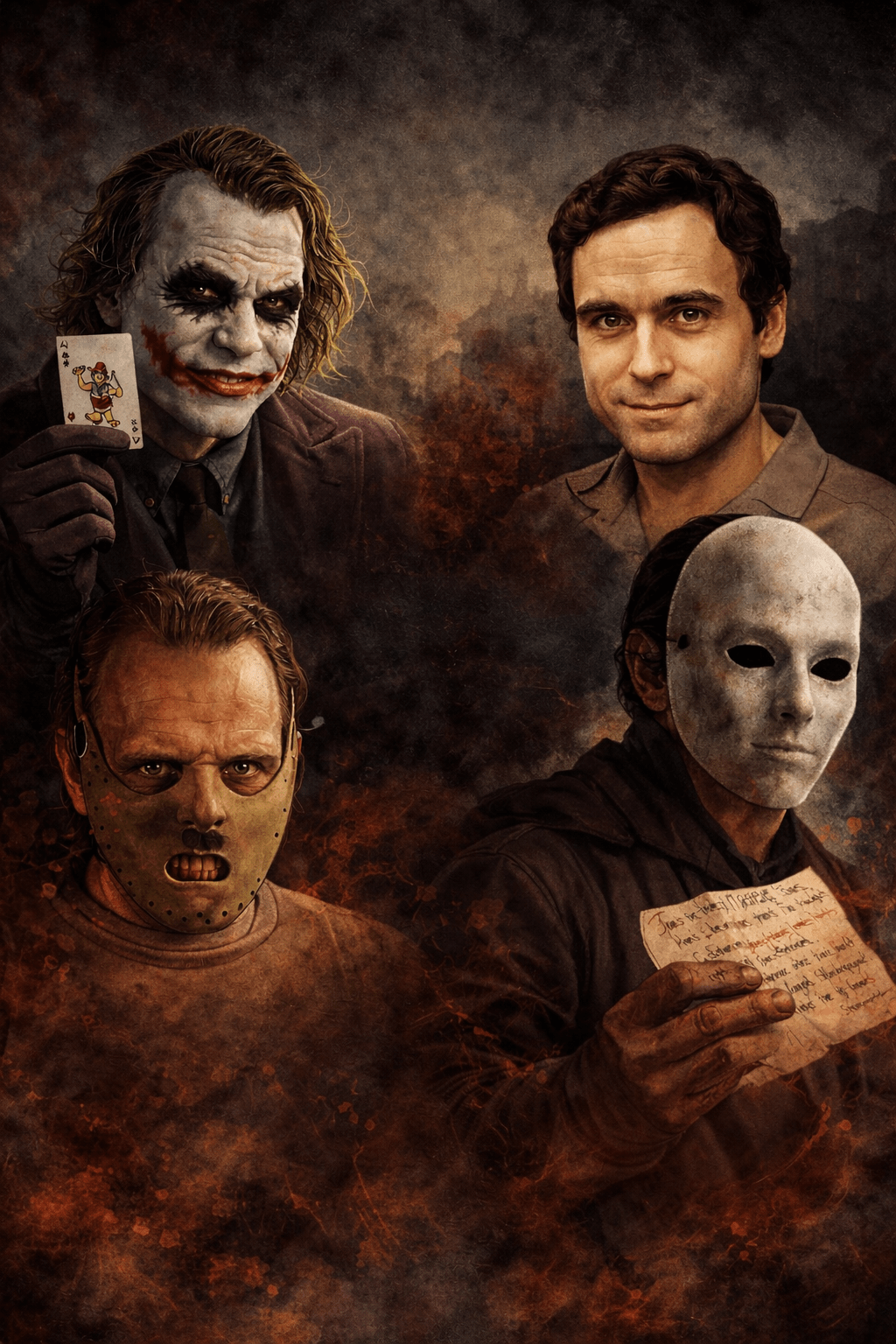
Throughout fiction and non-fiction alike, a certain type of person has made a lasting impact on those who are introduced to them: psychopaths. Whether they be true-to-life killers such as Ted Bundy or imagined ones like Hannibal Lecter, people always find themselves interested in the complex character archetype. So it would go without saying that creating such characters for your story would give it depth and intrigue, especially for those creating horror or thrillers. However, the idea of creating such a character and successfully doing so are two separate things.
Take the bombastic character of the Joker, in The Dark Knight movie, played by Heath Ledger. His performance was widely acclaimed and is viewed as an amazing portrayal of the flashy style of a psychopath. On the other hand, the performance by Jared Leto playing the same character in Suicide Squad was widely criticized, not just for the acting, but for the writing of the character. So what was the defining difference between a beloved and a hated character under the same name?
In this article, we will be exploring the founding principles of what makes a realistic psychopath as well as how to create an interesting one. So that when you are writing in your own psycho, he will be a Ledger and not a Leto.
There are many ways to define a psychopath’s characteristics, but for the sake of time, we will be going over three founding principles of a psychopath.
Lack of Empathy
Psychopathic characters always have a lack of feelings for others, which oftentimes gives them their air of menace. Being able to commit atrocities without feeling any remorse, the mass death of others, committing torture, or even the lack of drive to save someone who was close to them. These characters are not without their own feelings, however. Some will hold their own lives in much more esteem than others, and will often break when their own mortality comes into question. Other characters will desire the protection of their fixation over all else. Such as their “art,” which often is the macabre mutilation of their victims.
Manipulative
Psychopaths frequently manipulate others, and due to their lack of morality, take no issue with this. This manipulation is often done to uphold their “mask” of being a normal person, persuade their victims, or simply for the pleasure of being better than someone. In their eyes, it is not their fault that others are so gullible or weak as to be manipulated, and some may think that their victims deserve this treatment as recompense for their naivete.
Attention Seeking
While some psychopaths do have more emotional range than others, there does seem to be a pattern of attention-seeking among them. Some will find enrichment in leaving behind cryptic notes on their identity, making the hunt for a serial killer more exciting for the perpetrator. Others will make their killings an extravagant show. Or perhaps they find pleasure in the intimate experience of the killer and victim. This is all under the same idea that they wish to be seen, in one way or another.
Now that we have an idea of what determines a psychopathic character, it is up to the author to give life to this idea. Simply plopping in a psychopath with the stereotypical tropes isn’t going to earn the eye of the reader. Like any character, you must flesh out their character to devise their placement within the story. However, you must think differently when creating this style of character. To help formulate them, these questions can be used. What role does the psycho play in the story? What does their “mask” look like, compared to the real them? What is the character’s drive, such as needs, fixations, or goals?
Role
One might assume that this psychopath is the antagonist in the story. This is not always the case, even though it is easiest to place them there. You may also see into the distorted mind of the psychopath as the protagonist in some stories. Lastly, and my personal favorite: they will simply be in the story as a side character.
The psychopathic character also does not even need to be a killer or even a bad person. You often find these traits attributed to a psychopath due to their gravitation toward these actions. This character may find ease in taking a life and have a need to be seen; however, that does not dictate in which way. Oftentimes in actions or thrillers, the main character is a killer, but also deemed a hero. The hero finds it easy to kill, while also drawing the attention of others- how familiar.
Making the psycho a grey character is another excellent path to choose, showing off the full versatility of the character. Perhaps they are on the villain’s side one moment, and on the protagonist’s the next? They simply have their own will and find themselves to be of the most importance, so why pledge allegiance to anyone else?
Mask
It may be human nature to feel like you are putting on a show for others and not showcasing your true personality. Psychopaths know that they are putting on this mask and do it for their aforementioned traits, in order to manipulate and to garner attention. You must devise almost two separate characters for a psychopath. The personality they show the world, and the personality inside their minds.
It is very possible that this character never actually shows their true self, even in private with another, or even alone. Some will hold tight to their mask, only revealing their true selves inside the narrative of their mind or perhaps for only the author to know, but not acknowledge.
Devising these personalities is a key moment, especially for those whose psycho is the protagonist or antagonist. This dichotomy of the mask vs. self almost sets the tone for the book in some cases. If this prominent character’s mask shines through and connects with the audience enough, the impact of revealing their true self will be that much more meaningful.
This mask also separates the concept of the characters from the passive ones, such as Hannibal, to that of the Joker. While Hannibal’s mask is that of a thoughtful, caring man, the Joker almost literally wears one. The Joker we see is never the man who is actually behind the makeup. You can ascertain the thoughts of the character behind his portrayed personality via the words he says.
Goal
The desires of this type of character may be hard to grasp and complex. Their minds work differently so their wants and desires may not function the same as our own. This can almost be a twisted biological desire to do things. Some people may get a random voice in their head to do some absurd thing, which is instantly quelled by logic and morals. Instead, however, there is no corrective thought after the instant strange urge to do something, possibly morally wrong.
That is simply the surface level, though. Some, while still being a psychopath, have a bigger picture in mind. Perhaps they see the world as wrong, weird, or strange and wish to correct it. Or maybe the character has more human desires and simply just wishes to finally feel safe or happy and needs to find whatever that is for themselves.
This is another shining moment for the author to create uniqueness for their psychopath and perhaps help develop the story in doing so. For example, if your psycho’s desire is to surround themselves with a horde of people that admire them, whose lives he can manipulate and play with at will, what does he need to do to achieve this? What mask helps him accomplish this? What happens when he achieves this, and does this fulfill him if he succeeds?
Lastly, let’s take a look at some psychopaths in media to draw inspiration from. Just remember to simply take inspiration and not copy outright.
The Master- Doctor Who
The Master is a character throughout Doctor Who, but let’s narrow the lens to his appearance in season 3 of modern Doctor Who. He is a lively and comedic character in his mask, but internally he is a sadistic man plagued by “the sound of war,” which is often heard as a drum beat in his head. This is an excellent show of a psychopath, that also creates the character open enough to see all sides of him.
He lacks empathy almost to an inverse level, finding joy in the pain of others, so much so that it is nearly his goal to do so. His stated goal, however, is to control the universe, which can be deduced as his need to be seen by all. His role is obviously that of an antagonist, but he still shares a strange connection with The Doctor, giving more complexity to his character than just a villain. He is also seen manipulating others with not only his charming personality – his mask- but in true Doctor Who fashion with subliminal messaging and mind control.
The Governor- The Walking Dead
The Governor is the first true antagonist in the show, other than the hordes of zombies wandering around. He is seen by the people under him as a charismatic leader who knows how to get the job done, while those who go against him- or even those caught on his warpath- find a calloused and heartless killer who simply wishes to control everyone. If he does not get his way, he will sacrifice all his pawns just so that others suffer for defying him.
The Governor easily ticks all the boxes almost immediately upon encountering him in the show. His lack of empathy for killing those who are innocent and guilty alike without any remorse. His manipulation of an entire town that unknowingly follows him to kill others who are innocent, and that he disposes of at his own discretion. Lastly, his need for attention from the same denizens of his town that he needs to look up to him. Making him an obvious psychopath, but a prominent one.
Daenerys Targaryen- Game of Thrones
Yes, everyone’s favorite mother of dragons is indeed a psychopath and a more discreet one at that. Her role was that of a protagonist throughout most of the show, while at the end immediately reversed. Since this is a more complex example, I will go into more detail for this one.
Her lack of empathy can be confusing throughout the show; you see her care for those close to her while also throwing thousands of lives away simply because she was angry or wanted to get her way, even those whom she portrayed as close to her. Her attachment to these people was not from a human connection, but as beloved belongings.
Her manipulation of these people seemingly fell into her lap throughout the show, perhaps it was her doing, perhaps it was her luck, but most likely it was both. Near the end of the series, she had dragons, lords, and armies of several nations under her command.
“Daenerys Stormborn of the House Targaryen, First of Her Name, the Unburnt, Queen of the Andals and the First Men, Khaleesi of the Great Grass Sea, Breaker of Chains, and Mother of Dragons” -if her attention-seeking was not evident.
Her role was that of a hopeful protagonist to go against the surmounting enemies throughout the series, and in fact, she does so. That is, until the end of the series, when she has lost too many of her “possessions” and has decided that she no longer wishes to keep holding onto her mask and does away with enemies and allies alike.
Her mask was that of a caring queen who wishes to free slaves and save the world. Unfortunately, her actual purpose in doing many of her actions was to have control over more and more.
Her goal was obvious: to be the ruler of the seven kingdoms.
These characters are all prominent within highly famous media. Some are obvious examples, while others require more depth to perceive. Since this article was focused on the writing of these characters, you must show a purposeful amount of what you wish to reveal about your psychopath. To make a memorable, meaningful character, one must delve into the mind of the psychopath. Just remember to find your way out when you’re done.
 Slade Von Parade
Leave a comment